Seeing your baby’s blossoming smile as you pop out from behind your hands to say “peek-a- boo” and conversing with your baby through the language of coos and burbles are some of the more rewarding experiences of early parenthood. In fact, such moments of feeling in sync with another are an essential part of life as a social species.
Scientists have long known that rich and responsive social interactions between parents and infants are hugely important for the child’s early learning and development, and for their success in later life. However, today many parents work long hours and spend less time with their babies. Compared to previous generations, they also lack access to extended family support or community networks where they routinely observe others interacting with babies. On top of this, parents are bombarded with often conflicting advice from online influencers, which can lead to lower confidence and a loss of trust in their own instincts. As a result, some parents struggle to know how to connect with their children.
This is an important issue, as compromised early social interactions can have lifelong repercussions on the child’s psychological and neural wellbeing (Feldman, 2007; Leong, 2022) [1][2] increasing parental stress in the long run.
Feldman, R. (2007) Parent–infant synchrony: Biological foundations and developmental outcomes. Current Directions in Psychological Science 16(6): 340–5. DOI: https://doi.org/10.1111/j.1467-8721.2007.00532.x
Leong, V. (2022) Neural sociometrics: Toward early screening of infant psychosocial and brain health to improve lifelong mental well-being. Policy Insights from the Behavioral and Brain Sciences 9(1): 111–19. DOI: https://doi.org/10.1177/23727322211068020
Our research on parent–child interactions
Our research group, headed by Professor Victoria Leong at the Early Mental Potential & Wellbeing Research Centre (EMPOWER) at Nanyang Technological University in Singapore, aims to understand children’s development and parent–child connection from a social neuroscience perspective. As we aim to advance the scientific understanding of how parents and infants effectively relate to each other, we don’t study the child in isolation. Instead, we look at the parent and child as a unit, with a focus on the information they exchange with each other during their social interactions.
Social interactions are slippery beasts and it can be hard to pin down the magic ingredients that lead to mutually satisfying, productive interactions – the type known to boost learning in infants and strengthen the parent–child bond. Any individual interaction is made up of many different forms of communication, both conscious and unconscious, such as the use of sounds and words, gestures, eye contact and facial expressions. Sometimes a few milliseconds’ difference in timing or the angle of an eyebrow can change how such communicative expressions are received.
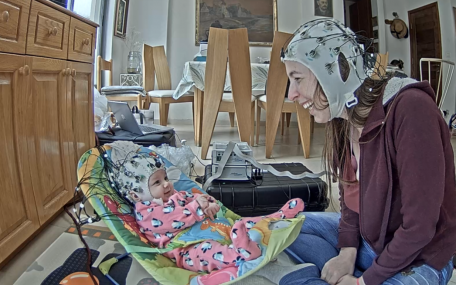
In order to study these interactions, we invite parents and infants to our research centre. We ask them to take part in semi-structured activities, such as singing songs and playing games, while wearing wireless EEG caps to measure their brain activity and cardiac monitors to measure their heart rate. We record these sessions on video, and then use computer vision technology and machine learning to identify body movements, changes in facial expression and gaze direction. We also analyse timings and expressive properties of speech patterns and verbal sounds. All of this data is combined to create a profile of the strengths and weaknesses of a parent–child pair.
We call this field of study “dyadic sociometrics”. “Dyadic” refers to two people being involved, and “sociometric” is the term we use for measurements of socially relevant behaviours.
The “dance” of synchrony
We like to think of social interactions as resembling partners dancing. Each partner is alert and attuned to the other’s signals and is constantly adjusting and adapting their timing and responses to ensure that the dance (or conversation) flows smoothly. As one partner moves forwards, the other moves back, and even when not in direct physical contact, they are aware of being part of a shared whole. These adaptive, moment-to-moment changes in responsive behaviours, such as body movements, eye contact and facial expressions, naturally lead to periods of synchrony. Synchrony means that each partner’s actions show that they are reacting and responding to the other, but not that they are exactly copying each other’s actions.
Behavioural synchrony, which refers to visible forms of connection like making eye contact or taking turns, has been studied for many years and is linked to many beneficial outcomes such as secure attachment and self-regulation skills. In our work, we also investigate neural synchrony, or the way that the brain activity of two people can become coordinated when they interact, which is a relatively new field of research. We hope this increases our understanding of how synchrony between parents and children relates to infant development and learning.

Research findings on neural synchrony
Although many questions remain about its role in communication, research into parent–child neural synchrony has shown promising links with successful communication and learning.
- Neural synchrony is associated with better communication between social partners (Hasson et al., 2012)[3] and cooperation between the parent and child, and improved emotion regulation in the child (Reindl et al., 2018)[4], likely to make parenting less stressful.
- An Austrian study showed that when mothers and their preschool children attempted a problem-solving activity, those with higher levels of neural synchrony were more successful at the task (Nguyen et al., 2020)[5].
- Neural synchrony is stronger when there is direct eye contact. A study of adults and 10-month-old babies showed that when the adult and baby made eye contact, their neural activity was more synchronised than when the adult was looking slightly away from the child. This suggests that eye contact is a cue that signals a readiness to communicate, making both partners more attuned and responsive to the other and in a ready state for communication and learning (Leong et al.,2017)[6].
Hasson, U., Ghazanfar, A.A., Galantucci, B., Garrod, S. and Keysers, C. (2012) Brain-to-brain coupling: a mechanism for creating and sharing a social world. Trends in Cognitive Sciences 16(2): 114–21. DOI: https://doi.org/10.1016/j.tics.2011.12.007
Reindl, V., Gerloff, C., Scharke, W. and Konrad, K. (2018) Brain-to-brain synchrony in parent–child dyads and the relationship with emotion regulation revealed by fNIRS-based hyperscanning. NeuroImage 178: 493–502. DOI: https://doi.org/10.1016/j.neuroimage.2018.05.060
Nguyen, T., Schleihauf, H., Kayhan, E., Matthes, D., Vrtička, P. and Hoehl, S. (2020) The effects of interaction quality on neural synchrony during mother–child problem solving. Cortex 124: 235–49. DOI: https://doi.org/10.1016/j.cortex.2019.11.020
Leong, V., Byrne, E., Clackson, K., Georgieva, S., Lam, S. and Wass, S. (2017) Speaker gaze increases information coupling between infant and adult brains. Proceedings of the National Academy of Sciences 114(50): 13290–5. DOI: https://doi.org/10.1073/pnas.1702493114
Such results suggest that measures of synchrony can serve as evidence of the quality of the interaction. As higher interpersonal synchrony between social partners has been related to social connectedness and feeling better about ourselves (Lumsden et al., 2014)[7], we expect that increased synchrony could further contribute to the parent’s sense of connection with their child, and their self-esteem.
Lumsden, J., Miles, L.K. and Macrae, C.N. (2014) Sync or sink? Interpersonal synchrony impacts self-esteem. Frontiers in Psychology 5. DOI: https://doi.org/10.3389/fpsyg.2014.01064
How this research can help parents
Understanding the importance of synchrony, and the cues that help two people to remain in sync, allows us to identify areas where the parent can be a powerful agent in improving the child’s social skills.
A promising potential application of our research is developing ways to measure sociometric profiles at a larger scale in community settings (i.e. outside of the research context), and then using these to devise personalised suggestions, based on the infant’s profile of strengths and weaknesses. These suggestions could be used for home-based intervention activities.
For example, if sociometric measures show that a parent and a 9-month-old child have lower-than- usual levels of turn taking and responding to one another, we can suggest a game like silly noises. When the parent blows a raspberry or vibrates their lips, the sounds will attract the baby to look at the parent, and also encourage the parent to pay attention to the baby’s reactions, including eye contact, facial expressions and noises. The parent is encouraged to leave spaces for the baby to respond between noises, and to reflect on whether the baby seems to be enjoying the game (and what this looks like), which sounds they respond to most, and whether the baby joins in with noises of their own. This kind of activity strengthens the communicative feedback loop between parent and child.
Understanding exactly which activities to suggest and how much they can help is a new and exciting avenue of research in our lab. We do not yet know which interventions will prove most successful, but we are hopeful that providing parents with activities tailored to their infant’s particular needs will not only support the child’s social and neuropsychological development, but also strengthen the parent’s own feelings of agency, adequacy and fulfilment.